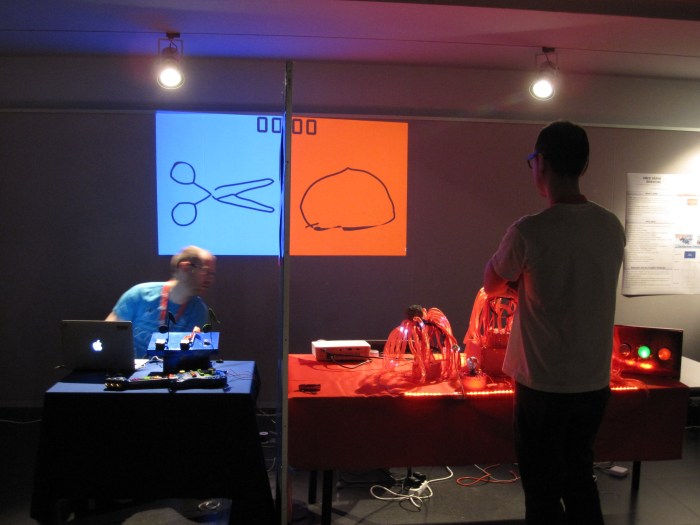
My involvement in the Rock, Paper, Awesome! (RPA) project was a key experience in exploring innovative ways to connect physically distributed communities that are nevertheless connected socially and professionally. This project, an investigation into tangible interactions and ambient representations, provided a unique opportunity to contribute to cutting-edge research in bridging physical distances through creative technology design.
RPA re-envisioned the classic game of Rock, Paper, Scissors as a mechanism to explore novel interactions across space and time. The core objective was to foster deeper connections between geographically separated but collaborating research labs, such as those in Toronto, Chicago, and Oslo. Key characteristics of the RPA project included:
- Open-Source Framework: Utilizing an open-source, message-based technology framework, RPA enabled participants in each location to design and implement their own unique tangible interactions and ambient representations.
- Universal Translator for Interaction: RPA served as a “universal translator,” mediating between different players’ workspaces (e.g., research labs, homes, galleries) and combining diverse communication modalities to create a common play space and distributed tangible interaction.
- Ambient Awareness: A crucial aspect was the use of ambient representations – incorporating lights, sound, and motion – to communicate game states and player actions. This allowed RPA to remain a persistent yet unobtrusive element in players’ physical spaces, resting on the periphery of their awareness until an actionable event occurred.
- Customizable User Experience: Powered by SAIL Smart Space (S3) and an Arduino microcontroller, the system allowed users to design how they engaged with the game, from choosing their “weapon” by sitting in a specific location or manipulating an object, to representing game states through custom music or waving flags.
As a contributing researcher and co-author on the project’s TEI 2013 publication, I collaborated closely with an interdisciplinary team to develop materials and interactions that aligned with the project’s goal of fostering community capacity and engagement. I explored tangible, embodied interactions that reflected the presence, workflow, and collaborative intentions of distributed participants, addressing the challenge of bridging spatial distance while maintaining social cohesion. The project also provided hands-on experience applying S3 concepts, investigating how embedded intelligence and ubiquitous computing could create seamless interactions within physical environments and support collaborative problem solving.
This experience strengthened my ability to design for distributed collaboration, cultivate community across distance, and integrate tangible and digital interactions in meaningful ways. It enhanced my skills in developing ambient, context-aware systems that communicate information unobtrusively while supporting engagement, creativity, and gamefulness. RPA also offered insights into designing open-source, participatory technologies that encourage user-driven innovation and iterative experimentation.
Beyond its technical and design achievements, RPA served as a prototype for exploring how physical and virtual environments can be combined to support shared understanding and knowledge exchange, laying the groundwork for my ongoing work in Future Learning Spaces and hybrid learning environments.
 Alisa Acosta