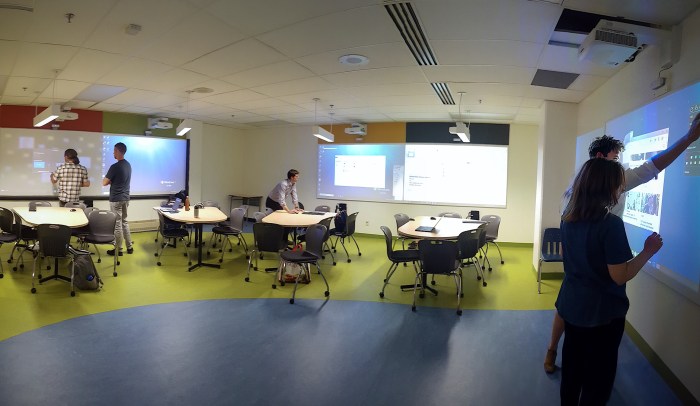
My work in Future Learning Spaces centered on reconceptualizing physical and digital environments for learning and knowledge creation. From 2011-2018, I was a key contributor to an international research effort investigating how learning spaces can be flexible, dynamically connected to learning, and act as multi-dimensional mediational tools that both shape and are shaped by learning communities. This research aligns with the critical need for coherent frameworks based on learning sciences principles to guide the construction and use of new educational spaces in pedagogically meaningful ways, moving beyond traditional instructionist approaches or mere “futurist” visions.
Central to my approach was the concept of smart spaces: physical environments embedded with intelligence, where agency is distributed among human participants, technological systems, and tangible artifacts. By designing these environments, the aim was to transform traditional classrooms and workspaces into dynamic hubs for collaborative inquiry and creative problem-solving. In these settings, tangible and ubiquitous computing play a crucial role. Technology is designed to “disappear” into the physical environment—integrated into walls, furniture, or objects—allowing participants to move, interact, and collaborate naturally, without being tethered to personal devices.
Another key dimension of this work was locational awareness, where intelligent spaces can detect the presence, location, and activity of individuals or groups. This enables adaptive delivery of content and resources tailored to participants’ roles or learning trajectories, supporting highly personalized and context-aware learning experiences.
I was also deeply interested in the relationship between human and software agency, including the application of delegation agents that allocate decision-making to the most appropriate actor—human or machine—based on task complexity, expertise, or context. These explorations had implications for educational design, collaborative workflows, and broader considerations in ethics, law, and societal governance.
Underpinning these technological and spatial innovations was my commitment to Knowledge Communities. I examined how physical arrangements and interactive environments could scaffold participation, helping learners progress from peripheral observation to authentic engagement in discourse and practice. By viewing space as a mediator of social configurations, I designed environments that both shaped and were shaped by the interactions of the community.
My practical experience spanned a range of projects, including co-authorship and participation in the International Symposium on Future Learning Spaces for Learning Communities. Through these experiences, I developed expertise in interdisciplinary research and design, collaborating with educators, software developers, and academic researchers to translate complex learning science principles into tangible, effective educational environments.
This work has strengthened my skills in pedagogical innovation, designing activities and scaffolds within unique learning contexts, and in interactive technology development, implementing tangible and ubiquitous computing systems, ambient displays, and open-source frameworks that seamlessly bridge physical and digital spaces. I have also honed my capacity for distributed collaboration and community building, devising technological and procedural strategies to connect geographically dispersed learners and teams, fostering a shared sense of purpose and knowledge.
Finally, my investigations into human-computer interaction and agency, combined with data-driven design approaches, have allowed me to create learning environments that are adaptable, responsive, and informed by real-time knowledge visualizations. Collectively, these contributions helped provide a coherent vision for the future of educational spaces, integrating physical, locational, and technological considerations with sound pedagogical principles. Through this work, I sought to empower learners, enhance collaborative knowledge creation, and prepare learning communities for the challenges and opportunities of the 21st-century innovation society.


 Alisa Acosta