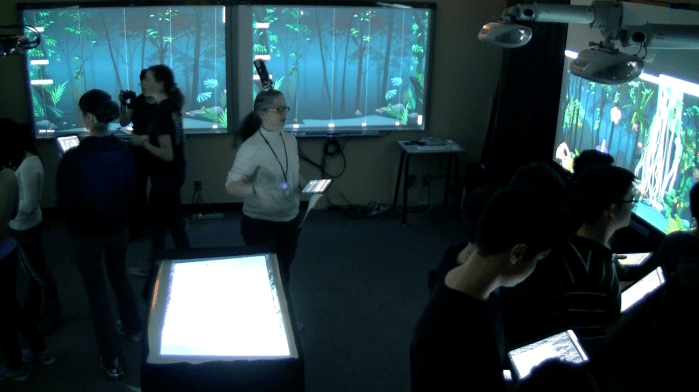
EvoRoom was a groundbreaking educational initiative originally designed and conceptualized by Michelle Lui as part of her PhD research, and which served as the foundation for my MA research. The project combined innovative curriculum design with a unique immersive “smart classroom” environment, allowing students to engage directly with phenomena that would otherwise be temporally or geographically inaccessible to them. The EvoRoom environment simulated the Borneo-Sumatra rainforest through large projected displays, interactive whiteboards, and custom software, situating learners within a richly contextualized, immersive ecosystem.
The curriculum was informed by the Knowledge Community and Inquiry (KCI) pedagogical model, which emphasizes the creation of a shared knowledge base within a learning community to support ongoing collaborative inquiry. Students engaged in EvoRoom activities across multiple contexts, including online at home, in traditional classroom lessons, on a field trip to a local zoo, and through two immersive experiences within the smart classroom. Key technological scaffolds included the SAIL Smart Space (S3) infrastructure and the Zydeco mobile application, which guided students in observation, data collection, and the construction of evidence-based arguments using a claim-evidence-reasoning framework.
For my MA research, I contributed to the final design iteration and implementation of EvoRoom in two Grade 11 Biology classes. My work focused on leading the epistemological analysis of this curriculum design, examining how students’ epistemic cognitions (i.e. their beliefs about knowledge and the nature of science) were shaped by this collaborative inquiry experience. I employed a Model-Based Design Research (MBDR) approach, first mapping the epistemic commitments of KCI against the curriculum design using Chinn et al.’s (2011) expanded epistemic cognition framework, and then analyzing how these epistemic elements were enacted in practice by students.
In collaboration with the high school teacher, programmers, and academic researchers, I provided feedback on the design and deployment of technological tools, including the Zydeco app, ensuring that they supported both the collective construction of knowledge and individual cognitive engagement. I conducted a mixed-methods analysis of student data, including statistical surveys, digital artifacts, and open-ended responses, to evaluate the curriculum’s effectiveness in fostering epistemic growth, collaborative inquiry, and a robust understanding of complex biological concepts.
The MBDR analysis of EvoRoom yielded both theoretical and practical insights. The study identified epistemic gaps in the curriculum design, particularly regarding students’ justification of knowledge and their epistemic stances, highlighting areas where technology scaffolds could better support evidence-based reasoning and knowledge negotiation. These findings informed a series of design recommendations for subsequent KCI curricula, emphasizing the need to make students’ knowledge contributions visible, to better capture knowledge negotiation processes, and to integrate mechanisms for evaluating the evidentiary rigor of collective reasoning.
From a practical perspective, participation in EvoRoom activities produced notable shifts in students’ reported sources of knowledge. Pre-curriculum surveys indicated heavy reliance on authoritative sources, whereas post-curriculum responses reflected a more balanced integration of authority, peer collaboration, and self-generated knowledge. Students also demonstrated improved appreciation for the value of community-based knowledge construction, reporting greater engagement and retention compared to peers who only participated in traditional activities. The immersive and interactive aspects of EvoRoom contributed to sustained learning, with a majority of students indicating that they expected to retain more knowledge from this unit than from other more conventional lessons.
Through this work, I gained extensive expertise in designing and evaluating complex, technology-rich inquiry environments, integrating theoretical models with practical curriculum implementation, and conducting rigorous analysis of collaborative learning processes. The co-design process with the partner biology teacher ensured the curriculum aligned with Ontario standards, demonstrating that immersive learning spaces can be implemented successfully at scale while providing a replicable model for other contexts, including museums, science centers, or future classroom simulations. Ultimately, EvoRoom exemplifies how thoughtfully designed immersive environments can advance both educational research and societal goals, preparing students to participate effectively in collaborative, knowledge-rich communities and a rapidly evolving, interconnected world.
 Alisa Acosta