In the summer of 2012, I joined ecologist, author, and conservation scientist, Dr. Cristina Eisenberg, on an expedition from Big Fork, Montana to Fairbanks, Alaska and back, in support of her research for The Carnivore Way: Coexisting with and Conserving North America’s Predators. This work explored the ecological necessity of apex predators and advocated for a continent-spanning wildlife corridor from Mexico to Alaska that would enable large carnivores such as wolves, grizzly bears, cougars, lynx, jaguars, and wolverines to roam freely across connected landscapes. My role on this journey was to assist in field documentation and contribute to the ecological and cultural observations that underpinned this work.
This cross-border journey provided an opportunity to engage directly with the real-world implications of landscape connectivity and predator ecology, from the expansive valleys of Montana to the remote boreal regions of interior Alaska. Along the way, we engaged with park biologists, conservation practitioners, local knowledge-holders, and subsistence land users—each offering unique perspectives on predator presence and ecosystem management.
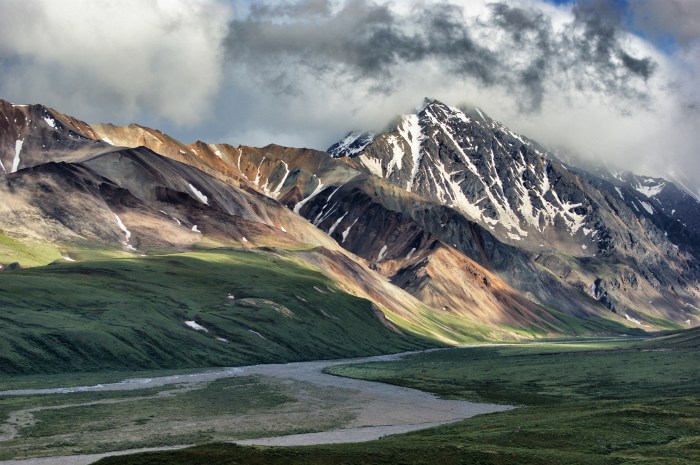
A highlight of this experience was our multi-day collaboration with Tom Meyer, Chief Biologist at Denali National Park. On our first day in Denali, we conducted an aerial wildlife survey in a small propeller plane, scanning vast expanses of alpine and tundra terrain for signs of carnivore activity—particularly wolves. This provided an unparalleled perspective on habitat use, movement corridors, and the scale at which these species interact with the landscape.
The following day, I participated in a wolf den expedition led by Meyer, where we visited several den sites and encountered the carcass of a deceased alpha female wolf. Her cause of death was undetermined, though Meyer speculated it may have resulted from complications during pregnancy. The absence of pups and signs of predation suggested a deeper ecological story—one rooted in the complex interplay of biology, behaviour, and environmental stressors. These field experiences deepened my understanding of carnivore life history, mortality, and the challenges of wildlife monitoring in remote environments.


While Dr. Eisenberg traveled to Katmai National Park to observe grizzly bear activity, I undertook an independent day trip to Seward, Alaska, where I explored the marine ecosystems of the Kenai Peninsula. This side excursion allowed me to broaden my ecological lens and consider the interconnectedness of terrestrial and marine systems, particularly in regions where climate change, human development, and species migration converge.


Our journey also brought us to Chitina, Alaska, a remote settlement on the Copper River, where we stayed in rustic guest cabins built entirely from local materials by a subsistence hunter and trapper known as “Apache Mike.” Mike, who had lived off the land since the early 1980s, shared insights into traditional ecological knowledge (TEK) and subsistence practices in the region. He prepared meals with freshly caught Copper River salmon, demonstrated how his fish wheels operated on the river, and shared stories of moose and Dall sheep hunting in the Wrangell-St. Elias wilderness. These experiences offered an intimate look at the human dimensions of wildlife conservation, particularly in areas where predator conservation intersects with the livelihoods of long-time land users.
We also explored the historic mining towns of McCarthy and Kennecott, gaining a deeper appreciation for the legacies of resource extraction and their ecological consequences—past and present.


Participating in this journey shaped my perspective on conservation science, interdisciplinary fieldwork, and the power of storytelling in communicating ecological truths. I developed skills in field observation, aerial wildlife monitoring, and ecological interpretation across diverse biomes, while also witnessing firsthand the delicate balance between wildlife conservation, local communities, and protected areas. Just as significantly, I came to appreciate the role that long-form narrative and public science communication play in shifting cultural attitudes and informing policy about predator coexistence.
This experience also reinforced my belief in the value of connected landscapes, and in fostering partnerships across ecological, institutional, and cultural boundaries in service of resilient, predator-inclusive ecosystems.
 Alisa Acosta